
Cryptocurrency has taken the financial world by storm, transforming how people think about money, transactions, and digital ownership. Whether you’ve heard about Bitcoin making headlines or seen people discussing crypto on social media, you might be wondering: What exactly is cryptocurrency, and how does it work? Cryptocurrency Explained.
In this in-depth guide, we’ll break down everything in simple, easy-to-understand language. By the end, you’ll have a solid understanding of it’s, how it operates, its benefits, risks, and why it matters in today’s digital world.
1. What Is Cryptocurrency?

Cryptocurrency is a kind of digital or virtual currency that uses cryptography for security.
. Unlike traditional money (like dollars or rupees), cryptocurrencies are not controlled by any central authority, such as a government or bank.
Instead, they operate on a technology called blockchain, which ensures transparency and security.
👉 In simple terms:
Cryptocurrency is digital money that you can use online without needing a bank.
2. The History of Cryptocurrency
The concept of digital currency existed for decades, but cryptocurrency became a reality in 2009 with the launch of Bitcoin. If we learn properly that Cryptocurrency Explained than we trade easily.
- Generated by an anonymous person (or group) known as Satoshi Nakamoto
- Designed for a peer-to-peer payment system.
- Aimed at eliminating the required for intermediaries such as banks.
After Bitcoin’s success, thousands of other cryptocurrencies were developed, including Ethereum, Ripple, and Litecoin.
3. How Does Cryptocurrency Work?
To understand how Cryptocurrency works, Cryptocurrency Explained, you need to grasp three key components:
a. Blockchain Technology
A blockchain is a distributed digital ledger that records all transactions across a network of computers.
- Each transaction is stored in a “block”
- Blocks are linked together in a “chain”
- Once recorded, data cannot be changed
👉 This makes cryptocurrency secure and transparent.
b. Decentralization
Unlike traditional banking systems, Cryptocurrency are decentralized.
- No single authority controls the network
- Transactions are verified by users (nodes)
- Reduces the risk of fraud and manipulation
c. Cryptography
Cryptography ensures that transactions are:
- Secure
- Private
- Tamper-proof
It uses complex mathematical algorithms to protect user data and funds.
4. What Is Blockchain in Simple Terms?
Think of blockchain like a digital notebook shared across thousands of computers.
- Everyone can see the entries
- No one can erase or alter them
- New entries are added only after verification
👉 This is why blockchain is considered trustworthy without needing a middleman.
5. Types of Cryptocurrencies
There are thousands of cryptocurrencies, but they generally fall into these categories:
a. Coins
These are standalone currencies like:
- Bitcoin is the world’s first it’s, created for secure peer-to-peer payments. It is widely used for investing, trading, and digital transactions globally.
- Litecoin is a fast and low-cost cryptocurrency designed for quick digital payments. It offers faster transaction speeds compared to many older cryptocurrencies.
b. Tokens
Built on existing blockchains:
- Ethereum-based tokens (ERC-20)
c. Stablecoins
- Pegged to real-world assets (like USD)
- Less volatile
d. Altcoins
- Any cryptocurrency other than Bitcoin
6. How Are Cryptocurrencies Created? (Mining Explained)
Cryptocurrency Explained, Cryptocurrency are often generated through a process is mining.
What Is Mining?
Mining is the process of:
- Verifying transactions
- Adding them to the blockchain
- Earning rewards in cryptocurrency
How It Works
- Computers solve complex mathematical problems
- The first to solve gets rewarded with coins
- This keeps the network secure
👉 Mining requires powerful computers and consumes significant energy.
7. How Do You Use Cryptocurrency?
You can use it’s in several ways:
a. Buying Goods and Services
Some companies accept crypto payments.
b. Investing
People purchase crypto hoping that its value will up.
c. Sending Money
- Fast international transfers
- Lower fees than banks
d. Trading
Purchasing and selling crypto on exchanges for profit
8. What Is a Crypto Wallet?

where your store it’s a Crypto wallet & Cryptocurrency Explained.
Types of Wallets
a. Hot Wallets
- Connected to the internet
- Easy to use
- Less secure
b. Cold Wallets
- Offline storage
- More secure
- Ideal for long-term holding
👉 Wallets store your private keys, not the actual coins.
9. What Are Private and Public Keys?
It”s uses two types of keys:
Public Key
- Like your bank account number
- You can share it to receive funds
Private Key
- Like your password
- Must be kept secret
⚠️ If someone gets your private key, they can access your funds.
10. Advantages of Cryptocurrency
it’s offers several benefits:
a. Decentralization
No central authority controls your money.
b. Security
Blockchain technology makes transactions secure.
c. Lower Fees
Cheaper than traditional banking systems.
d. Fast Transactions
Especially for international transfers.
e. Financial Inclusion
Accessible to people without bank accounts.
11. Disadvantages of Cryptocurrency
Despite its advantages, crypto also has risks:
a. Volatility
Prices can change rapidly.
b. Lack of Regulation
Limited government oversight.
c. Security Risks
Hacks and scams can occur.
d. Irreversible Transactions
Once sent, you cannot undo a transaction.
12. Is Cryptocurrency Safe?
it’s itself is secure, but how you use it matters.
Safety Tips:
- Use trusted exchanges to buy and trade Cryptocurrency Explained safely. Reliable platforms offer stronger security, better customer support, and protection against fraud or hacking risks.
- Keep your private keys secure because they provide access to your it’s wallet. Never share them online, and store them safely to avoid theft or losing funds permanently.
- Enable two-factor authentication (2FA) to add extra security to your crypto accounts. It requires a second verification step, helping protect accounts from unauthorized access.
- Avoid suspicious links and scams by checking website addresses carefully and ignoring fake offers. Scammers often use phishing tricks to steal passwords and cryptocurrency funds.
👉 The biggest risk is human error, not the technology.
13. Cryptocurrency vs Traditional Currency
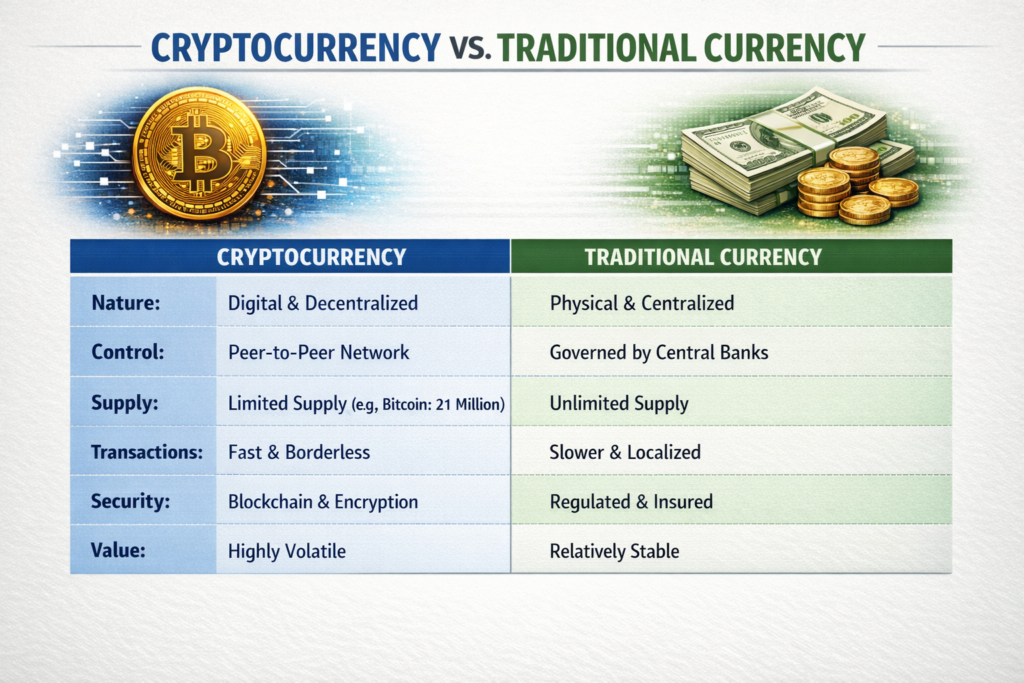
| Feature | Cryptocurrency | Traditional Currency |
|---|---|---|
| Control | Decentralized | Centralized |
| Form | Digital | Physical & Digital |
| Speed | Fast | Slower |
| Fees | Low | Higher |
| Transparency | High | Limited |
14. The Future of Cryptocurrency
it’s is still evolving, but its future hope looks promising.
Trends to Watch:
- Increased adoption by businesses
- Government regulations
- Central Bank Digital Currencies (CBDCs)
- Integration with everyday apps
👉 Many experts believe crypto will play a major role in the future of finance.
15. Common Cryptocurrency Terms You Should Know
Here are some important terms :
Blockchain is a digital ledger that records it’s transactions securely and transparently. It stores data in connected blocks across many computers worldwide.
A crypto wallet is a digital tool used to store, send, and receive cryptocurrency safely. Wallets can be mobile apps, software programs, or physical hardware devices.
Mining is the process of validating it’s transactions using powerful computers. Miners solve complex problems and earn new coins as rewards for their work.
A token is a digital asset built on an existing blockchain network. Tokens are often used in apps, games, decentralized finance projects, and online services.
16. Should You Invest in Cryptocurrency?
Investing in it’s can be profitable, but it’s not without risks.
Before Investing:
- Do your research
- Start with small amounts
- Diversify your portfolio
- Be prepared for volatility
👉 Never invest money you cannot afford to lose.
17. Real-Life Examples of Cryptocurrency Use
It is already being used in real life:
- Online shopping
- Freelance payments
- Remittances (sending money abroad)
- Gaming and digital assets
18. How to Get Started with Cryptocurrency
If you’re a beginner, follow these steps:
- Choose a reliable crypto exchange
- Create an account
- Verify your identity
- Deposit funds
- Buy your first cryptocurrency
- Store it safely in a wallet
FAQs About Cryptocurrency Explained

1. What is cryptocurrency?
it’s is a digital form of money that uses cryptography for security. It operates on decentralized networks called blockchain systems instead of traditional banks.
2. How does cryptocurrency work?
it’s works through blockchain technology, where transactions are recorded on a public digital ledger maintained by computers worldwide.
3. What is blockchain technology?
Blockchain is a secure digital database that stores transaction records in blocks connected together. It helps keep it’s transactions transparent and secure.
4. Is cryptocurrency legal?
The legality of it’s depends on the country. Some countries fully support it, while others restrict or ban its use.
5. How can beginners buy cryptocurrency?
Beginners can buy it’s through online exchanges using bank transfers, debit cards, or digital payment methods after creating an account.
6. What are the most popular cryptocurrencies?
Some popular it’s include Bitcoin, Ethereum, and Binance Coin.
7. Is cryptocurrency safe to invest in?
it’s can be risky because prices change quickly. Investors should research carefully, use secure wallets, and only invest what they can afford to lose.
8. What is a crypto wallet?
A crypto wallet is a digital tool that stores cryptocurrency and allows users to send, receive, and manage their digital assets securely.
9. Can cryptocurrency be converted into cash?
Yes, it’s can usually be exchanged for traditional money through crypto exchanges, peer-to-peer platforms, or crypto ATMs.
10. Why do people invest in cryptocurrency?
People invest in it’s for potential profits, financial freedom, fast global transactions, and access to decentralized financial systems.
11. What is cryptocurrency mining?
Mining is the process where computers solve complex problems to validate transactions and create new cryptocurrency coins.
12. What are the risks of cryptocurrency?
Common risks include market volatility, hacking, scams, regulatory changes, and losing access to wallet passwords or private keys.
13. Can cryptocurrency be used for online payments?
Yes, many businesses and online platforms accept it’s payments for products, services, and subscriptions.
14. What is the future of cryptocurrency?
Many experts believe it’s and blockchain technology may continue growing in finance, gaming, online payments, and digital ownership.
15. Do I need technical knowledge to use cryptocurrency?
No, beginners can use it’s with basic knowledge, though learning about wallets, security, and blockchain is highly recommended.
Conclusion

It is more than just a trend—it’s a revolution in how we think about money. Cryptocurrency Explained by using blockchain technology, it offers a secure, transparent, and decentralized way to handle transactions without relying on traditional financial systems.
While it comes with risks like volatility and security concerns, the potential benefits—such as financial freedom, low transaction fees, Cryptocurrency Explained, and global accessibility—make it an exciting opportunity for the future.
If you’re new to crypto, take your time to learn, stay cautious, and make informed decisions. With the right knowledge, you can confidently explore the world of cryptocurrency and possibly benefit from this digital financial revolut