
In this blog we will be know Drop-shipping VS Print-on-Demand.
So, online store that’s you want to start You’ve seen the ads, watched the success stories, and you’re ready to take the leap. But there’s a fork in the road, and you’re staring at two popular options: dropshipping and print-on-demand.
At first glance, they look almost identical. Without holding inventory both let you sell the product. Both require minimal upfront investment. Both promise the dream of running a business from your laptop.
But here’s the truth: they are fundamentally different businesses. One is a logistics puzzle focused on sourcing and selling. The other is a creative playground centered on design and branding. Choosing the wrong one can lead to frustration, wasted time, and lost money.
Let’s break down exactly how Drop-shipping VS Print-on-Demand work, their pros and cons, and—most importantly—which one is actually right for you.
What Is Dropshipping?
Dropshipping is a retail fulfillment model where you sell products directly to customers, but you never actually touch the products yourself. ? When a customer places an order on your store, you forward that order to a supplier (usually based in countries like China, the US, or Europe), who then ships the product directly to your customer’s doorstep.
Think of it as being the middleman. You set up the store, handle the marketing, and collect the profit margin between what you charge the customer and what you pay the supplier.
What You Can Sell
Pretty much anything. Electronics, home goods, pet supplies, fitness equipment, furniture, toys—you name it. Dropshipping suppliers offer massive catalogs with thousands of products.
The Good Side
- Low startup cost: You don’t buy inventory upfront. You just pay the supplier after a customer pays you.
- Scalability: You can add thousands of products to your store without ever renting a warehouse.
- Location independence: As long as you have internet access, you can run your business from anywhere.
- Wide product selection: You can experiment with different niches and products without being locked in.
The Challenging Side
- Thhttps://earnwithmehtab.com/wp-admin/post.php?post=1564&action=editin profit margins: Because the barrier to entry is low, competition is fierce. Many sellers compete on price, which squeezes profits.
- Shipping headaches: Suppliers often have slow shipping times (especially if they’re overseas). Customers expect Amazon-speed delivery, and delays can lead to refund requests and negative reviews.
- Little control over quality: You don’t see the product before it ships. If the supplier sends a defective item, you’re the one dealing with an angry customer.
- Supplier dependency: Your entire business relies on a third party. If they run out of stock, ship late, or go out of business, so do you.
What Is Print-on-Demand?
Print-on-demand (POD) is a specialized e-commerce model where you create custom designs—logos, artwork, slogans—and a supplier prints them onto blank products only after a customer places an order. Drop-shipping VS Print-on-Demand.
The product is created after the sale. You’re not selling generic goods; you’re selling your own unique designs on items like t-shirts, hoodies, mugs, phone cases, posters, and tote bags.
What You Can Sell
Customizable blank products. The most popular categories are apparel (t-shirts, hoodies, sweatshirts), accessories (hats, socks, bags), and home decor (mugs, pillows, wall art).
The Good Side
No Inventory Risk
No inventory risk means you don’t need to buy or store products in advance. You only purchase items after a customer places an order, reducing financial risk, storage costs, and the chance of unsold stock.
Creative Control
Creative control allows you to design your products, branding, marketing style, and customer experience freely. Drop-shipping VS Print-on-Demand. You can shape how your business looks and feels to match your vision and attract your target audience.
Higher Perceived Value
Higher perceived value means customers see your product as more premium or unique. Strong branding, quality presentation, and good marketing can make products feel more valuable, even if production cost is low.
Easier Branding
Easier branding means you can quickly build a recognizable identity for your business. With consistent logos, designs, and messaging, customers remember your store and trust your products more easily.
No Minimum Orders
No minimum orders mean you can start selling without buying large quantities. This reduces startup costs and lets you test products in the market before investing heavily in stock or production.
The Challenging Side
- Lower profit per item: The cost of printing and fulfillment is relatively high. You might make $10–$15 profit on a $30 t-shirt, but scaling requires volume.
- Limited to customizable products: You can’t sell electronics, tools, or general merchandise. Your offerings are confined to printable surfaces. Dropshipping vs. Print-on-Demand: Which Is Best.?
- Quality varies by supplier: Not all POD providers use the same printing methods or blank garments. A poor-quality print can hurt your brand reputation.
- Marketing is everything: Since you’re selling designs, your success depends almost entirely on your ability to market them effectively through social media, ads, or organic reach.
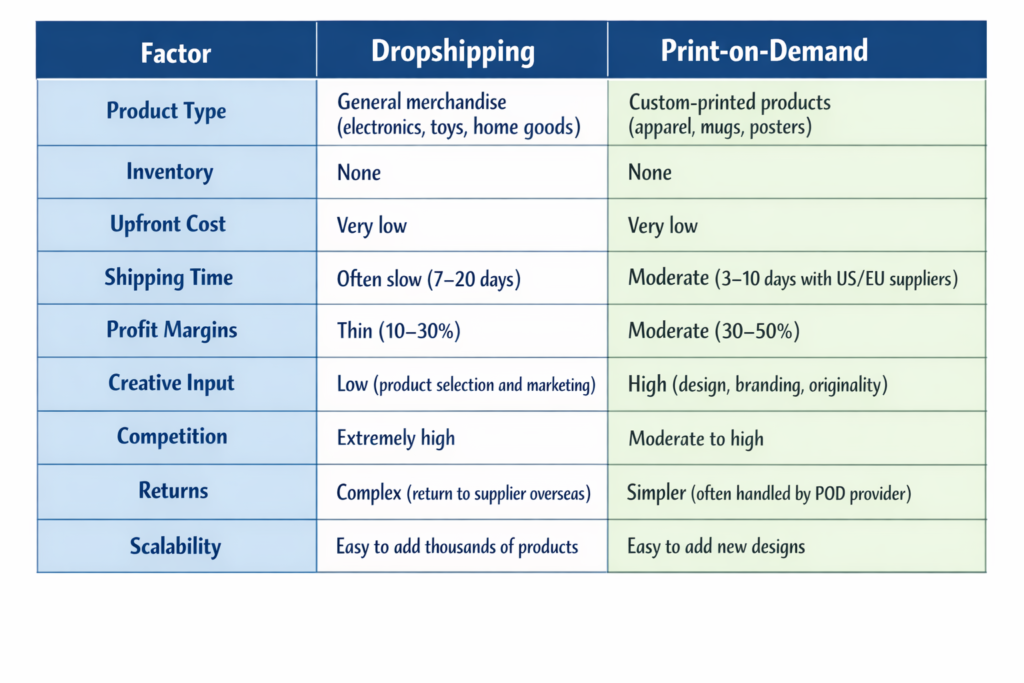
Key Differences at a Glance
Which One Is Right for You?
The answer depends entirely on your skills, interests, and goals. Let’s make it simple. Drop-shipping VS Print-on-Demand.
Choose Dropshipping If:
You love marketing and sales
If you love marketing and sales, you enjoy promoting products, understanding customer needs, and convincing people to buy. It means you are comfortable with communication, creativity, and building strategies to increase revenue and grow a business.
You want to sell a huge variety of items
Wanting to sell a huge variety of items means you are open to working with different product categories. It allows you to explore multiple markets, attract diverse customers, and increase earning potential through flexible business opportunities.
You have patience for logistics
Having patience for logistics means you can handle shipping, inventory management, order tracking, and delivery delays calmly. It requires organization, problem-solving skills, and the ability to manage operations smoothly for customer satisfaction.
You’re okay with fierce competition
Being okay with fierce competition means you can survive and grow in a crowded market. It requires confidence, smart strategies, “Drop-shipping VS Print-on-Demand” continuous improvement, and the ability to stand out from competitors in pricing, quality, or service.
Best for: Entrepreneurs who enjoy the thrill of product research, competitive analysis, and scaling through paid advertising.
Choose Print-on-Demand If:
- You’re creative. You have an eye for design, a unique artistic style, or a clever way with words. Your designs are the product, not just a wrapper. Dropshipping vs. Print-on-Demand: Which Is Best.?
- You want to build a brand. POD allows you to create a cohesive identity around your niche—whether it’s funny cat shirts, motivational fitness gear, or minimalist home decor.
- You prefer simplicity. With POD, your supplier prints and ships. You focus on designs and marketing without worrying about supply chain chaos.
- You’re building for the long term. A strong POD brand grows through repeat customers and organic recognition. It’s slower to start but can become a loyal community.
Best for: Designers, artists, creators, and anyone who wants to turn their ideas into tangible products without managing inventory.
The Hybrid Approach

Here’s a secret many successful e-commerce entrepreneurs use: you don’t have to pick just one. Drop-shipping VS Print-on-Demand.
Some store owners start with print-on-demand to test their brand and audience. Once they have a winning design and consistent sales, they transition to holding inventory (or using a fulfillment service) to increase profit margins and offer faster shipping.
Others use dropshipping for general merchandise while adding a POD line to create branded merchandise that builds loyalty.
Both models can coexist beautifully in the same store.
FAQs About Drop-shipping VS Print-on-Demand

1. What is drop-shipping?
Drop-shipping is an online business model where sellers market products without keeping inventory. Suppliers store, pack, and ship products directly to customers.
2. What is print-on-demand?
Print-on-demand is a business model where custom designs are printed on products like shirts, mugs, or hoodies only after a customer places an order.
3. What is the main difference between drop-shipping and print-on-demand?
Drop-shipping sells ready-made products from suppliers, while print-on-demand focuses on customized products created with unique designs or artwork.
4. Which business model is easier for beginners?
Both are beginner-friendly, but print-on-demand may be easier for creative individuals, while drop-shipping suits those focused on product research and marketing.
5. Do both models require inventory?
No, neither model requires storing inventory. Products are handled and shipped by third-party suppliers after customers place orders.
6. Which model has lower startup costs?
Both have low startup costs, but print-on-demand may require design tools or artwork, while drop-shipping often requires more advertising expenses.
7. Can people make good profits with drop-shipping?
Yes, profits are possible with winning products, strong marketing, and reliable suppliers, although competition can be very high.
8. Is print-on-demand more creative than drop-shipping?
Yes, print-on-demand allows sellers to create unique branded designs and customized products for specific audiences or niches.
9. Which model has faster shipping?
Shipping speed depends on suppliers and customer locations. Some drop-shipping suppliers offer faster delivery than print-on-demand services.
10. What products are commonly sold in drop-shipping?
Popular drop-shipping products include gadgets, fashion items, beauty products, home accessories, and fitness equipment.
11. What products are commonly sold in print-on-demand?
Print-on-demand businesses often sell t-shirts, hoodies, phone cases, posters, mugs, tote bags, and notebooks with custom designs.
12. Which model has better branding opportunities?
Print-on-demand usually offers better branding because sellers can create original designs and build a unique identity around their products.
13. Is advertising important for both business models?
Yes, successful businesses often rely on social media marketing, paid ads, influencer collaborations, and strong online branding.
14. Can both models be connected to online stores?
Yes, both models can integrate with platforms like Shopify, WooCommerce, and Etsy.
15. Which model has higher competition?
Drop-shipping generally has higher competition because many sellers can access the same trending products from suppliers.
Final Verdict

If you’re a marketer and hustler who loves finding products to sell and scaling through ads, dropshipping will feel like home.
If you’re a creator and storyteller who wants to build a unique brand around your designs, print-on-demand is your path.
Neither is a get-rich-quick scheme. Both require effort, learning, and patience. But the beauty of 2026 e-commerce is that the barrier to entry has never been lower. Drop-shipping VS Print-on-Demand. Whether you choose to sell the next trending gadget or your own original artwork, the opportunity is real—if you’re willing to put in the work.
Now, the question isn’t which model is better. It’s which one fits you.